
International Travel Checklist: 21 Things to Do Before You Fly
An international trip falls apart in the small gaps. The passport expiring in four months when the destination requires six. The debit card that gets frozen the first time you swipe it abroad. The plug adapter you meant to buy and then stood in a Geneva hotel room holding a dead phone while your reservation confirmation sat in your inbox.
This international travel checklist is the fix. It walks through documents, money, health, tech, and packing in the order you should actually handle them, from two months out to the morning of your flight. Work through it section by section and you will catch the expensive mistakes before they catch you.
Passports, Visas, and Entry Requirements
Start with the document that gets you on the plane. Everything else on this international travel checklist can be fixed at the destination; a passport problem strands you at home.
Check your passport’s expiry date first. This is the single most common reason travelers get turned away at check-in. Many countries — all 26 in the Schengen Area, Thailand, Indonesia, and most of South America — require your passport to be valid for at least six months beyond your planned return date. The U.S. State Department’s own guidance tells citizens to treat the six-month rule as the default, not the exception. If your passport falls short of that window, renew it before you book anything non-refundable. Routine U.S. renewals currently run four to six weeks; pay for expedited service if you travel within six weeks.
Confirm whether you need a visa, and confirm it early. U.S., UK, Canadian, and Australian passport holders can enter most of Europe, Japan, South Korea, and much of Latin America visa-free for short stays, but the rules change without much noise. The European Travel Information and Authorisation System (ETIAS) is rolling out for Schengen countries, and new e-visas appear regularly in Asia. Check the destination’s official embassy or consulate site rather than a third-party summary — the embassy page is the only source that reflects current policy.
Photograph every document, front and back. Store encrypted copies of your passport, visa, driver’s license, and any prescriptions in your email or a cloud folder you can reach from a borrowed computer. A photo on your phone is not the same as a cloud backup, because your phone is the thing most likely to get stolen or broken.
Money and Payment Setup
Money problems abroad are rarely about not having enough — they are about not being able to reach what you have.
Notify your bank and credit card companies. A card declined at a Lisbon hostal because the fraud algorithm flagged a foreign transaction is a solvable problem, but only if you can call your bank, which means an international roaming charge or hunting for Wi-Fi. Most banks now let you set travel notices online in two minutes. Do it for every card you plan to carry.
Carry at least two forms of payment that are not connected to each other. One debit card and one credit card from different banks is the minimum. If one is frozen, cloned, or swallowed by an ATM, the other still works. Leave the second card in your hotel safe, not your wallet, so a pickpocket never gets both.
Decide on cash before you land. Order a small amount of foreign currency from your bank a week out — enough for a taxi from the airport and your first meal. For everything beyond that, withdrawing local currency from a bank-owned ATM on arrival almost always beats currency-exchange counters and airport kiosks, which routinely take 8–15% in fees and spreads. Decline the ATM’s “dynamic currency conversion” prompt, which converts the transaction at a worse rate so the machine operator can skim a margin.
| Factor | Airport exchange desk | Bank ATM abroad |
|---|---|---|
| Exchange rate | 8–15% above mid-market | Near mid-market |
| Fees | Hidden in the spread | Your bank’s ATM fee, if any |
| Convenience | Open when you land | Widespread, 24/7 |
| Best for | Emergencies only | Everyday cash |
Health and Insurance
Two things to lock down before you think about packing cubes: your health coverage and your body.
Schedule a travel-medicine consult four to six weeks out if your destination sits in a region with vaccine requirements or recommendations — sub-Saharan Africa, parts of Southeast Asia, and the Amazon basin all have yellow fever and malaria considerations, and some countries require proof of vaccination before entry. A travel clinic or your primary care doctor can map out what you need, and many required vaccines need weeks to take effect.
Confirm your insurance actually covers the trip. Standard domestic health plans often provide little to no coverage outside your home country, and Medicare does not cover care abroad. A single night in a hospital overseas can cost $10,000 or more. Read the fine print on your policy, compare travel insurance cost per trip against what you are already paying, and understand how much travel insurance really costs before you decline it. For frequent travelers, an annual policy usually beats per-trip coverage.
Refill prescriptions before you leave. Bring enough medication for the full trip plus a one-week buffer, keep it in original labeled bottles, and carry a copy of each prescription if any of your medications are controlled substances, which some countries restrict at the border.
Booking and Logistics
This is where a trip planning session on a budget saves you money — and where a checklist saves you from showing up to the wrong airport on the wrong day.
Reconfirm every confirmation number. Flights, hotels, trains, and tours all in one place, with booking reference numbers, dates, and addresses. Screenshot or download the confirmations because airport check-in counters and border agents are not impressed by your word.
Know the entry form situation. Some countries still require paper arrival and departure cards; a growing number require an online arrival form completed days or hours ahead. Indonesia’s e-customs declaration, Australia’s Incoming Passenger Card, and various digital passenger locator forms all catch travelers who assumed they could fill out everything at the counter.
Build your itinerary with slack. Flights get delayed, trains get missed, and a rigid schedule that stacks a connecting flight, a boat, and a dinner reservation in one day is a schedule built to break. Leave at least a three-hour buffer on any travel day with a hard connection, and give yourself a genuinely free first day to shake off the flight.
Tech and Connectivity
Your phone is now the trip’s most critical piece of gear: map, translator, boarding pass, and camera rolled into one. Treat it that way.
Photo by Matthew Turner via Pexels
Unlock your phone before you go. If your carrier has your device locked, get it unlocked now so you can drop in a local SIM or eSIM at your destination. Roaming plans from U.S. and Canadian carriers typically run $10–$15 per day and add up fast; a local data eSIM often costs $10–$20 for a full week to a month of data.
Download offline maps and translations. Google Maps offline areas and the language pack for Google Translate or Apple’s Translate app work without a connection, which matters exactly when you actually need them — lost, late, and away from Wi-Fi.
Bring a universal plug adapter and a power bank. One adapter is a false economy; two is the difference between charging your phone and your camera at the same time. A power bank of at least 10,000 mAh rides in your day bag, not your checked luggage, because lithium batteries are restricted in the hold.
Notify your emergency contacts. Give one person at home a copy of your itinerary, your passport number, your travel insurance policy number, and the hotel where you are staying. If something goes sideways, someone who is not with you knows exactly where to start.
Packing by the Checklist
Packing is where good trips go to die — not from a lack of stuff, but from too much of the wrong stuff or a missing critical item discovered at 30,000 feet.
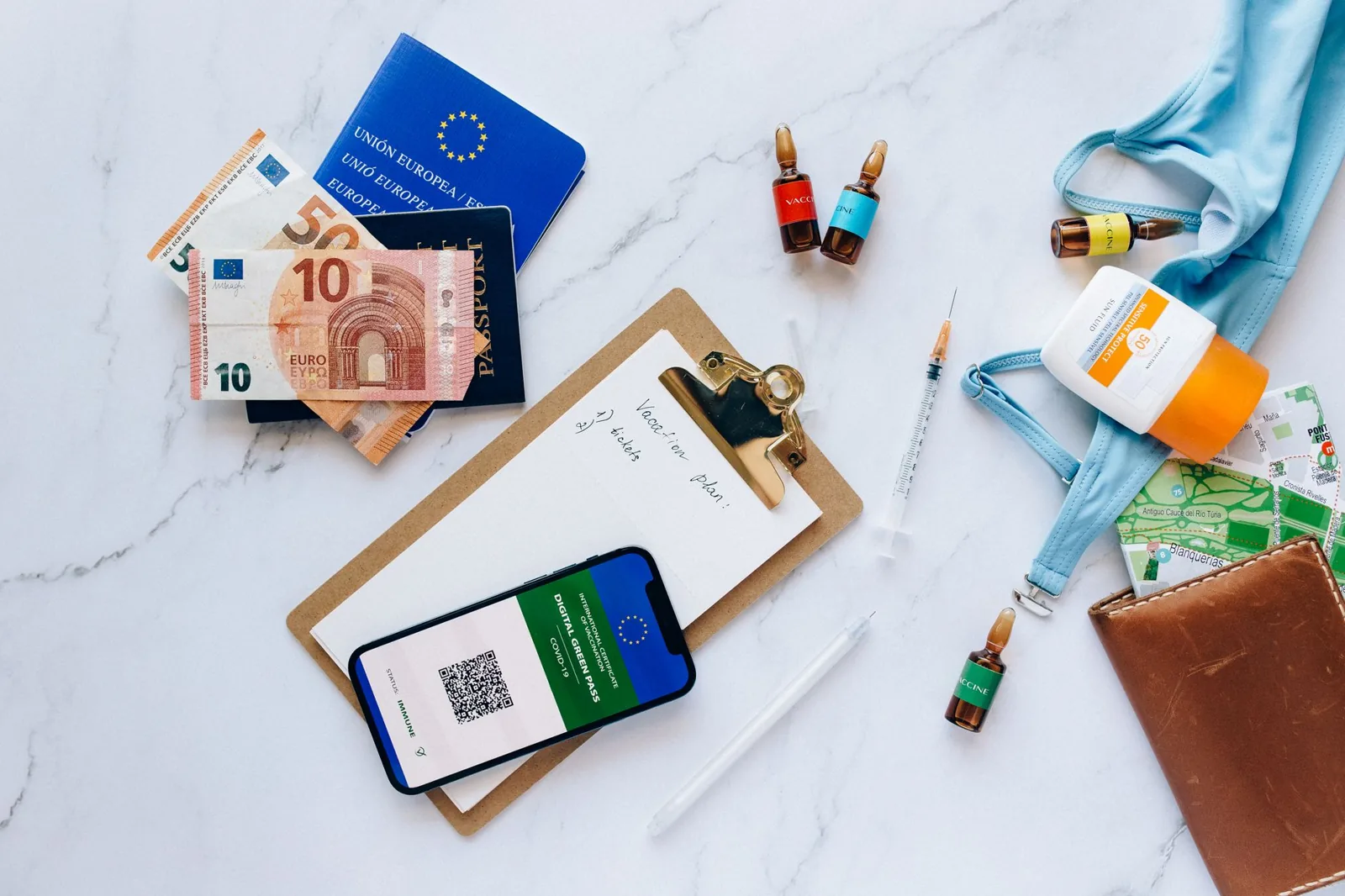
Photo by Nataliya Vaitkevich via Pexels
Carry-on the things that matter. Passport, wallet, phone, chargers, medication, a change of underwear, and one outfit of clothes all go in your personal item. Airlines misplace checked bags on roughly 1 in 200 flights in a good year and worse during peak season, and the bag they lose is never the one with just shoes.
Check the weather, then pack layers, not volume. A rough budget for a full vacation should already tell you what you can spend, but it will not tell you it drops to 8°C at night in the desert or that shoulder season means rain every afternoon. Pack for the coldest and wettest version of the forecast, and pick clothes that layer rather than a separate outfit for every climate.
Keep the liquids and the rules straight. TSA and most international equivalents allow one quart-size clear bag of liquids, each container 100 ml (3.4 oz) or under, in your carry-on. Buy travel-size anything that is not sold at your destination cheaply, and remember that gels, pastes, and creams count as liquids.
Make the “don’t forget” list physical. The small items are the ones you will forget: a pen for immigration forms, a copy of your hotel address (not just the name) for the arrival card, a spare pair of glasses or contact lenses, and a lock for your luggage. Write these down and check them off the night before.
Frequently Asked Questions
What should I do first on an international travel checklist?
Check your passport expiry date against the six-month rule. It is the one item that can cancel your whole trip with no workaround, and renewals take weeks. Everything else can usually be fixed in the days before departure.
How far in advance should I start preparing for an international trip?
Start the document and health items two months out, money and booking confirmations two weeks out, and packing three days out. The single most important early task is visas and vaccines, both of which can have multi-week lead times.
Do I really need travel insurance for international travel?
For most people, yes. Medical evacuation alone can cost $50,000 or more, and most domestic health plans offer little overseas coverage. Compare your options before you assume your credit card’s built-in coverage is enough — it often is not.
How much cash should I carry when traveling internationally?
Enough for ground transport from the airport and your first meal — typically the equivalent of $100–$200. Beyond that, withdraw from bank-owned ATMs at the destination and never accept dynamic currency conversion.
Can I use my phone normally abroad?
Only if you plan for it. Unlock your device, buy a local eSIM or SIM for data, and download offline maps before takeoff. Otherwise you will pay $10–$15 per day in roaming or hunt for Wi-Fi all trip.
What is the most common thing travelers forget?
A pen, a printed hotel address for the arrival card, and a spare pair of glasses. The cheap, boring items are the ones that vanish from memory because they are never flagged as important — until you need them mid-flight or in an immigration line.
The Bottom Line
An international trip rewards the traveler who thinks two months ahead on documents and health, two weeks ahead on money and logistics, and three days ahead on packing. This international travel checklist exists to turn those deadlines into a habit, so the morning of your flight is about coffee and boarding passes rather than panicked phone calls to your bank.
Lock the passport, insurance, and payment setup now. Then let the planning for the actual vacation be the fun part it should be. For broader guidance on what a well-run trip looks like from the first budget line to the last checked bag, the U.S. State Department’s traveler checklist and Lonely Planet’s practical pre-trip guidance are both worth a read. Safe travels.